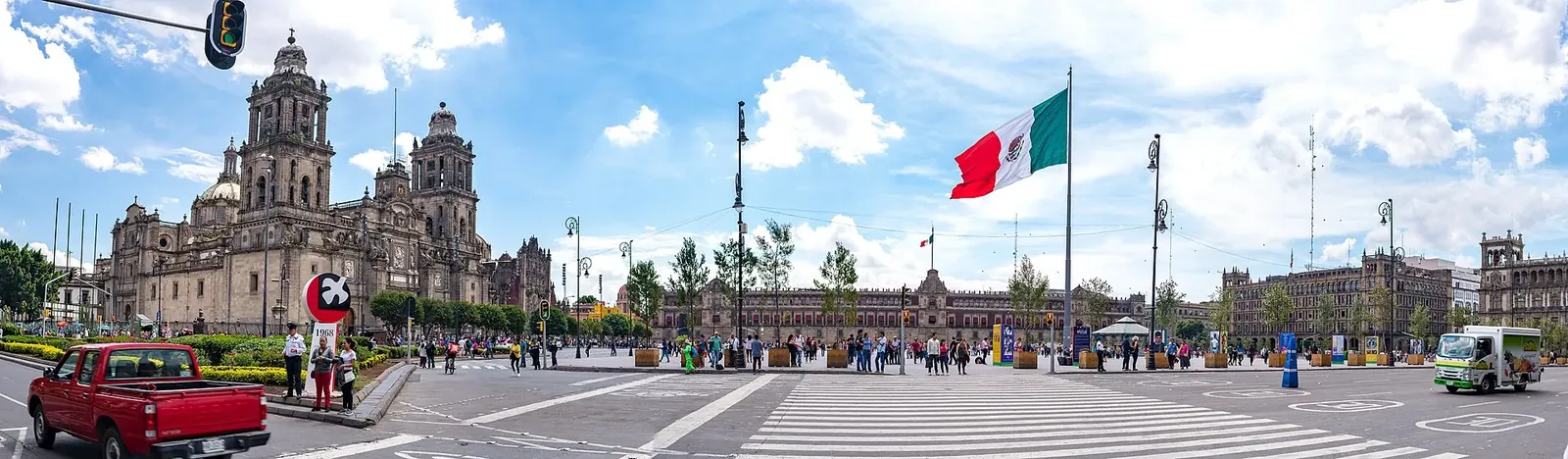
The biggest remote-work bargain in North America: a world-class capital, one of the cheapest metros on earth, and a 4-year path to permanent residency.
World-class food, culture and weather at half of US prices, with the most straightforward residency path in the Americas.
Can I get a visa?
Mexico City’s main routes. Open one for the full requirements, fees and application steps.
Mexico Temporary Residency (Residente Temporal)
The Residente Temporal visa lets you live in Mexico for up to four years, with unlimited entries and exits, and converts to permanent residency at the end of the four years.
Visa needs: USD 4,600/monthTypical budget: ≈ USD 1,750/mo
Processing: Consulate decision: same day to 10 business days. Visa sticker is single-entry, valid 180 days. After entry, you have 30 calendar days to begin the canje at INM; the resident card typically arrives 2-6 weeks after the appointment.
US curriculum with IB Diploma; English instruction
Fees: MXN 278,100-353,800 (USD 16,100-20,500)/yr (academic year 2026/2027)
School
Greengates School
British curriculum with IB; English instruction
Fees: MXN 120,000-640,000 (USD 7,000-37,100)/yr
School
Colegio Peterson
American curriculum with IB; bilingual
Fees: MXN 120,000-275,000 (USD 7,000-16,000)/yr
Healthcare
How care works
Mexico has two tiers.
Private hospitals: Médica Sur, Hospital Ángeles Pedregal, ABC Medical Center (American British Cowdray)
Moving there
For a full household move from the US, land freight through Laredo is the standard corridor into central Mexico. The menaje de casa is the duty-free one-time import of your used household goods, and it must be certified at a Mexican consulate in your home country before you travel: it cannot be done after arrival.
3-4 months out
decide what ships, what gets sold or stored; request mover quotes.
2 months out
consulate visa appointment; once you have the visa sticker, start the menaje de casa certification at the consulate.
0-30 days after arrival
complete the canje at INM and get your resident card; the menaje de casa only works with finalized residency.
Within 6 months of visa issuance
your household goods must enter Mexico under the menaje de casa.
We are vetting the first 3 partners in Mexico City. No paid placements, ever: firms earn a listing by passing our checks, not by paying.
Apply as a partner
Get your Mexico City moving timeline
Tell us your email and planned move month. We will send your checklists at the right time, no spam.
Frequently asked questions
Can I apply at any Mexican consulate, or am I stuck with my local one?
Most US consulates serve specific states or counties, and in general you apply where you live; Canada's consulates are similarly mapped by province. In practice some consulates accept applicants from outside their jurisdiction when appointments are unavailable locally, so it pays to check two or three consulates for availability. Verify your consulate's exact requirements no more than 30 days before your appointment, because documentation preferences differ.
What bank documents actually prove the income?
Six months of bank statements for the income route, twelve months for the savings route. Many consulates want statements stamped or certified by the bank rather than home-printed PDFs, and since 2026 several consulates refuse to let you combine income and savings to reach a single threshold. Cryptocurrency statements are not accepted unless backed by a signed statement from a recognized financial institution. Show balances comfortably above the line, not exactly on it.
Do I need an RFC to rent an apartment?
Not to sign a lease as a tenant: no law requires the tenant to have an RFC. But you will need one quickly for everything else: opening a Mexican bank account, buying a car, getting utilities in your name, and formal contracts. Get your CURP first (free, same day at a Registro Civil or INM office with your resident card and apostilled birth certificate), then register at a SAT office (free, about 30 minutes, book at citas.sat.gob.mx). Bring a local accountant if your Spanish is limited.
Can I drive on my US or Canadian license?
As a tourist, yes: a valid foreign license works for up to 180 days. As a resident, get a Mexican license; it doubles as the most useful local ID and avoids long explanations at checkpoints. There is no exchange agreement, so you apply from scratch at a SEMOVI office in CDMX: passport, resident card, proof of address, a written test, and usually no driving test if you hold a valid foreign license. Note the deadline: Mexico City's permanent (no-expiry) license stops accepting new applications on December 31, 2026; after that it is term licenses only.
How long does the whole process take, from consulate to card?
Consulates decide in anything from same-day to 10 business days. The visa sticker in your passport is a single entry valid for 180 days. Once you enter Mexico you have 30 calendar days to begin the canje at INM: file the online application, pay the fee, and give fingerprints and a photo. The plastic resident card typically follows in 2-6 weeks, and at some offices is issued the same day. Start the INM application in your first days in the country: appointment slots in Mexico City fill up.
Does temporary residency let me work in Mexico?
Not by itself. The economic-solvency route is a non-lucrative visa: it proves you can support yourself without taking a Mexican job. To work for a Mexican employer or as an independent professional you need a separate work permit (permiso para trabajar) from INM, which costs about USD 250 in 2026. Working remotely for foreign clients while on the solvency route is the standard pattern for digital nomads.
What happens after four years?
You apply at INM to change status from Residente Temporal to Residente Permanente. On the four-year route there is no further income test; the 2026 card fee is USD 790, a one-time payment. Your first temporary card is always issued for one year, renewable for 1, 2 or 3 more years at a time up to four years total. Notify INM of any address change within 90 days of moving.
The peso amounts keep changing year to year. Why?
Mexico sets the thresholds in multiples of the UMA (Unidad de Medida y Actualización), an inflation index INEGI recalculates every January and which takes effect February 1. For 2026 the daily UMA is USD 7, so the income bar is 680 x 117.31 = USD 4,600 a month. Each consulate converts to dollars at its own monthly rate, which is why San Diego quotes USD 4,510/mo while Las Vegas quotes USD 4,630/mo. If you read a figure that does not divide cleanly by 117.31, it is last year's number.